
Posted by Gabriel Brangers on Oct 7th 2026
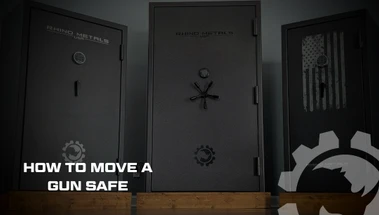
HOW TO MOVE A GUN SAFE
A gun safe is one of the few things people buy that they genuinely cannot move afterward. A refrigerator is awkward. A piano is heavy and expensive to repair. A safe is both of those, except it is a sealed steel box with nothing good to grab, and it does not forgive a mistake on a staircase. Most of them get set down on delivery day and stay in that exact spot for twenty years. Then comes a remodel, or a move, and suddenly you are standing in a doorway doing math.
I have watched this go badly more than once, and almost every time, the mistake was made before anyone laid a hand on the safe. And yes, for the record, I have been guilty of this myself. Unloading a 1,000 pound RSX7241 in the rain with just two people, a dilapidated appliance dolly and zero plan of attack ended a about as well as you would imagine. Thankfully, no one was injured but the safe did end up face down in the driveway at one point. The decision happens in the planning, not the lifting.
Start With The Actual Number
Not a guess, and not what the showroom tag said. Find the net weight for your exact model, which is on the product page and in our catalog. The spread is enormous. Across our own line, a Longhorn starts around 133 pounds and a loaded Thunderbolt clears 1,500. Those two numbers describe completely different jobs. One is a careful afternoon with a good dolly and a friend. The other is not a job for you at all.
Empty it first, all of it. Guns, ammo, documents, and the shelves if they lift out. Ammunition is deceptively dense. A few cans of it can add more weight than you would guess, and it is the easiest weight you will ever remove.
Then measure the path. Doorway widths, the tightest turn, ceiling height at the stairs, and the width of the stair treads. Measure the safe with the handle and any protruding hardware included, because that is the dimension that actually has to fit. Granted, this takes twenty minutes and feels like procrastination. It is the cheapest twenty minutes in the whole project.
When To Stop And Hire Someone
I would rather put this near the top than bury it at the bottom, because it is the part that keeps people out of an emergency room. A safe that tips can crush or kill, and the injuries that happen most often come from exactly one thing: getting your hands underneath the base. Professional riggers use a Johnson bar, a wheeled lever with a thin steel toe plate that is sometimes sold as a pry lever bar, specifically so nobody ever has to.
Safe-moving specialists generally treat anything past 500 to 600 pounds as a job for trained crews with the right rigging, and I think that is the right line. That said, hiring out is not an admission of anything. It's making a wise decision pertaining to your property and more importantly, your personal safety.
The Equipment That Matters
A standard hand truck from the garage is not the tool. You want a heavy-duty appliance dolly rated well above your safe's weight, with a belly strap. That strap is not optional. It is what keeps the safe married to the dolly when the center of gravity shifts. Add ratchet straps, moving blankets, a sheet of hardboard or plywood to protect flooring and spread the load, work gloves, and closed-toe boots. Furniture sliders help enormously on carpet and tile. And if you want the lever the pros use, a Johnson bar rents for around $27 at many equipment yards, which is a much easier decision than the $150 to $300 it costs to buy one for a single move.
Do not plan on lifting it. The NIOSH lifting equation starts from a load constant of 51 pounds and then adjusts downward for awkward posture, distance from the body, and twisting. All of those describe moving a safe. OSHA sets no fixed maximum, but even a modest 400-pound safe split between four people is twice that constant each, in the worst possible posture. The dolly does the lifting. You do the steering.
Stairs Are The Part That Hurts People
If there is one section to take seriously, it is this one. On stairs the safe's weight shifts on every single tread, a missed step damages both the staircase and the safe, and the margin for correction is essentially zero. Going down is more dangerous than going up, because gravity is working for the safe and against you the entire way.
Nobody stands downhill of the safe. Ever. If it gets away from the crew, the person below it has nowhere to go. Spotters work from the sides and above, never in the fall line.
A proper stair job uses a stair-climbing dolly, one person controlling the handles, and others bracing from the sides, with the descent braked deliberately one tread at a time. If reading that made you picture your own staircase and wince, that is useful information. Pay someone.
Will The Floor Hold It
This question comes up constantly for second-floor and bonus-room installs, and it deserves a straight answer. Under the International Residential Code, typical living areas are designed for a 40 pounds-per-square-foot live load, with floor systems also required to handle a 300-pound concentrated load on a six-inch square. A safe concentrates far more weight into far less area than that distributed figure assumes.
That does not automatically mean your floor fails. Load spreads through the joists, and plenty of safes live happily on second floors. It does mean placement is not arbitrary. Set the safe perpendicular across the joists rather than parallel to a single one, keep it near a load-bearing wall rather than the middle of a long span, and consider a plywood pad to distribute the footprint.
Where my confidence runs out: I am not a structural engineer, and neither is your moving crew. If you are putting several hundred pounds above a living space, an hour of a local engineer's time is cheap compared to the alternative, and they will tell you in one visit whether you need blocking underneath.
What It Costs To Hire Out
Less than people expect, which is the main reason I push so hard on this. Industry pricing guides put a standard local gun safe move in the range of roughly $250 to $550, with the full spread running from about $175 for a small safe on flat ground to $1,000 or more for a heavy one with complications. Crews are commonly billed hourly, in the neighborhood of $135 for two movers, $180 for three, and $225 for four, usually with a two to three hour minimum.
Stairs are the big variable, typically adding somewhere between $75 and $300 per flight depending on the company and the difficulty. Granted, that stings on a quote. It is still less than a replacement staircase, a refinished floor, or a single trip to urgent care. A reputable crew also carries insurance for the times it goes wrong anyway.
Anchor It Before You Load It
The move is not finished when the safe is in the room. An unanchored safe can be walked, tipped, or carried off outright, and a tipped safe is dangerous to anyone nearby, children especially. Every Rhino safe is pre-drilled for floor anchoring and this is the one step people skip because the hard part feels over.
Anchor it, level it, then load it. Doing it in that order means you are not working around 400 pounds of contents to reach the bolt holes.
Buying Before You Move
If you are shopping and already know the safe is going somewhere awkward, weight and footprint are worth deciding on before finish and capacity. Every spec sheet on our site lists net weight and exterior dimensions.
Shop Gun Safes Shop AccessoriesSources: International Residential Code, Chapter 5 (floor live loads); NIOSH Lifting Equation via CCOHS; OSHA Standard Interpretations on manual lifting limits; published 2026 pricing guides from professional safe-moving companies.