
Posted by Gabriel Brangers on Sep 23rd 2026
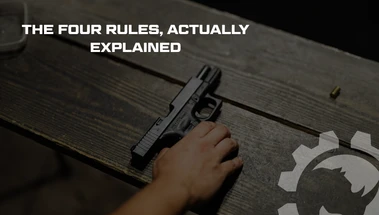
THE FOUR RULES, ACTUALLY EXPLAINED
Every new shooter hears them within the first five minutes of their first range trip, usually from whoever's standing closest with a clipboard. Keep it pointed safe. Finger off the trigger. Treat it like it's loaded. Know your target.
Most people can recite all four back within a week and never think about them again, the same way you can recite a fire drill without ever wondering why you're supposed to feel the door before opening it. That's a problem, because rules you don't understand are rules you eventually get sloppy with.
So here's what each one is actually protecting against, not just what it says.
Rule One: Treat Every Gun As If It's Loaded
This isn't really about the gun. It's about you. The moment you let yourself believe "I already checked, it's empty," you've handed your judgment over to a memory that might be wrong, a chamber you didn't actually clear, or someone else who touched it after you did.
Treating every gun as loaded means your behavior doesn't change based on a belief you can't fully verify. It's not paranoia, it's just removing one variable that's caused a lot of accidents by people who were absolutely certain they were right.
Rule Two: Never Point It At Anything You're Not Willing To Destroy
Muzzle direction is the one rule that does real work even when every other rule fails. If the gun somehow fires when it shouldn't, whether from a mechanical fault, a startle, or someone forgetting rule one, this is the rule that decides what actually gets hit.
Worth knowing: this one takes real discipline to apply consistently, because "anything you're not willing to destroy" includes your own foot while you're loading a magazine and your buddy's truck while you're getting gear out of the trunk. It's not just about the target downrange.
Rule Three: Keep Your Finger Off The Trigger Until Your Sights Are On Target
Your finger goes on the trigger guard, alongside the frame, or straight out along the barrel, not inside the guard, until the exact moment you've made the decision to fire.
Startle reflexes are real. A sudden stumble, a loud noise, a dog running into frame, all of these can close a hand involuntarily, and if your finger is already on the trigger, that reflex becomes a discharge. Keep the finger off the trigger and the worst a startle can do is make you flinch.
Rule Four: Know Your Target And What's Beyond It
This is the rule people understand least, because it sounds like it's only about aiming well. It's actually about what happens after a hit, or a miss.
Bullets go through things. They go through walls, through animals, through the person you meant to hit and into whatever's standing behind them. Knowing your target means knowing what's past it too, and being genuinely willing to not take the shot if you can't answer that.
Why There Are Four Of Them
No one of these rules is redundant with the others, even though it can feel that way when you're reciting them. They're layered on purpose, so that one mistake doesn't turn into an accident by itself. That's the whole design.
A finger that slips is caught by a muzzle pointed somewhere safe. A muzzle that drifts is caught by a chamber you were treating as loaded and therefore handling with care in the first place.
Where An Article Runs Out
I'll be honest about where my own confidence runs out here: this explains the reasoning behind four rules, it doesn't teach you to shoot. If you've never handled a firearm before, the next step isn't another article, it's an actual class with a real person watching your hands.
Any of these puts an instructor a few feet away for a few hours, correcting the small habits an article can't see. I can explain why rule three exists. I can't watch your trigger finger.
What The Rules Don't Cover
What these rules don't cover is what happens between range trips, when the gun isn't in your hands at all. That's a separate set of habits, mostly about where the thing lives when nobody's actively using it.