
Posted by Gabriel Brangers on Oct 19th 2026
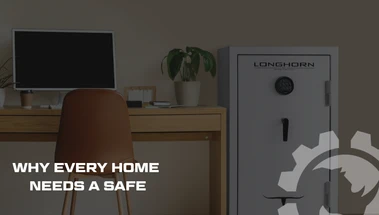
WHY EVERY HOME NEEDS A SAFE
If your house caught fire tonight, what could you not replace? Not the TV. Not the couch. Insurance handles those, more or less. We mean the passport in the kitchen drawer. Your kids' birth certificates. The title to the truck. The Social Security cards. The ring your grandmother wore for fifty years that currently lives in a jewelry box on the dresser.
Somewhere in the United States, a home structure fire is reported every 96 seconds, according to the National Fire Protection Association.
Most people file safes under "gun stuff." We build gun safes in Caldwell, Idaho, and have for a long time, so you would expect us to lead with firearms. We're not going to. The strongest argument for owning a safe has almost nothing to do with what you shoot and almost everything to do with what you could never get back.
A Safe Isn't Just For Guns
Ask people what's actually inside their safe and firearms are rarely the whole answer. It's the deed and the mortgage paperwork. The will. An envelope of emergency cash. A backup drive holding twenty years of photos. Prescription bottles. Tax returns. The jewelry that only comes out for anniversaries and funerals.
Firearms, if there are any, are one line on that list.
A home safe isn't a gun accessory. It's the one spot in your house where the irreplaceable things are protected from fire, from theft, and from hands that shouldn't reach them. Here are six reasons that matters, starting with the one most people underestimate.
Reason 1. Fire Doesn't Check Your Odds
There were roughly 329,500 home structure fires in the U.S. in 2024, causing about 2,920 civilian deaths and around $11.4 billion in direct property damage, according to NFPA data.
Those fires aren't spread evenly across the calendar. About 46% of home structure fires and 55% of home fire deaths happen between November and March, based on NFPA averages. Furnaces come on. Space heaters come out of the closet. Fireplaces get lit, kitchens run hot, and the air gets dry. The risk concentrates in the cold months, and the cold months are here.
You can't plan around whether a fire starts. You can plan around what's left standing when it's out.
A fire-rated safe is built for exactly that window. The body is insulated, so the interior climbs far slower than the room around it. The door carries a heat-activated seal that expands when temperatures rise, closing the gap between door and body against smoke and hot gases. The goal is simple: keep the inside cool long enough for the fire to be knocked down and burn out.
Paper and digital media don't have the same tolerance. A hard drive or memory card gives out under heat and humidity well before paper chars. If backups are going in, be sure to check the fire rating.
Reason 2. Burglary Is Down. Your Loss Isn't.
Here's the part that doesn't help us sell anything.
Burglary in this country is at a record low. The national rate was 229.2 per 100,000 in 2024, the lowest in FBI records going back to at least 1961, per FBI crime data. Your odds are genuinely better than your parents' odds. Anyone telling you break-ins are surging is selling something.
Now the other half of the picture. That record-low rate still came out to 405,776 residential burglaries in 2024, roughly 52% of all burglaries reported. More happened in daylight (216,601) than after dark (174,053), which runs against what most of us picture. Average loss ran $4,986 for a daytime burglary and $4,368 at night.
And recovery is unlikely. Only 13% to 15% of reported burglaries were cleared by police in 2024. Once something walks out your door, it generally doesn't come back.
Which brings up hiding spots. Security professionals have said the same thing for decades: the clever hiding place isn't clever. The sock drawer, the freezer, the shoebox on the closet shelf. Someone moving quickly through your house starts in the bedroom and already knows the list. A hiding spot works right up until somebody thinks of it. A bolted-down safe doesn't depend on anyone failing to think of it.
Reason 3. Your Insurance Covers Less Than You Think
Most people assume their policy covers their belongings up to the contents limit. It does, with exceptions, and the exceptions are aimed squarely at the valuable stuff.
A standard HO-3 homeowners policy carries sub-limits along these lines, according to the Insurance Information Institute's sample policy:
| Cash and coins | $200 total |
| Jewelry, watches and furs (theft) | $1,500 total |
| Firearms (theft) | $2,500 total |
| Securities, personal records, passports, manuscripts | About $1,500 |
That last cap includes the cost to research, replace, or restore the documents, per insurance agent guidance.
Run it against something real. A $5,000 ring is stolen. The jewelry theft sub-limit caps the claim at $1,500. Your deductible comes out of that. You aren't made whole, you're handed a fraction and a lesson.
And a check was never going to replace the ring anyway. Nobody files a claim on their mother's wedding band and feels covered.
Do this tonight. Sub-limits vary by insurer and policy, and a rider can raise them for an added premium. Pull your declarations page and read the personal property section. Then decide whether you'd rather carry that gap or close it.
Reason 4. Your Documents Are Worth More To A Thief Than You Think
Identity theft reports to the FTC hit 1,358,253 in 2025, up 19.6% from the year before, according to FTC Consumer Sentinel data.
Most of that starts online, not in your filing cabinet. We're not going to pretend otherwise. But look at what's in that cabinet: Social Security cards, birth certificates, passports, tax returns listing full income and account numbers, bank statements. That's precisely the set of documents someone needs to open credit in your name.
Lose a laptop and you lose a password. Lose that folder and you've handed over a complete identity, assembled and verified.
It doesn't take a professional, either. A box goes missing in a move. Somebody grabs the whole drawer because sorting takes time. And you may not find out for months, when something odd turns up on a credit report.
Those papers belong behind a lock. Retrieving them costs you one minute on the rare day you need them.
Reason 5. Curious Kids And Houseguests
Nearly 60,000 emergency room visits a year come from young children getting into medication on their own, according to CDC data collected between 2012 and 2015. About two-thirds of those visits involve children two years old or younger. Around 9% result in hospitalization.
Almost none of it involves a careless parent. It's a purse set down on a chair. A pill organizer on the nightstand, because the organizer is what makes the routine work. A visiting grandparent's weekly dispenser in an open suitcase. Child-resistant packaging slows a toddler down, it doesn't stop one.
The same reasoning covers everything else that shouldn't be casually reachable: firearms first, but also cash and private paperwork. Kids, their friends, overnight guests, a repair tech in the back bedroom.
This isn't about suspecting anyone. Almost everyone who walks through your door is exactly who they seem to be. A locked door just removes the question.
Reason 6. Ready When It Counts
FEMA recommends storing paper documents in a fireproof and waterproof box or safe at home as part of its Emergency Financial First Aid Kit, and Ready.gov advises keeping a small amount of cash at home in a safe place. Card readers and ATMs stop working when the power does.
Picture an evacuation. Wildfire moving your direction, water rising, a gas leak down the block. You have fifteen minutes, maybe five, and you're not thinking clearly.
If your important papers live in four different places, you leave with whatever you remembered. If they live in one place, you leave with all of it.
A safe gives your household a default location. When you're rattled and the clock is running, a default location beats a good memory.
Who Needs A Home Safe? A 30-Second Check
If any of these are in your home right now, a safe earns its footprint.
Most households check five or more of these without owning a single gun. Renters included: a safe can bolt into a closet floor and come with you at the end of the lease.
What To Look For
A full buyer's guide is its own article. Here's the short version: four things to compare.
Fire rating. Look for both numbers: the temperature and how long the safe is rated to hold at it. A rating without a duration tells you very little.
Pry resistance. Most forced entry attempts are a pry bar at the door seam, not a drill or a torch. This is where our SafeX® locking system comes in: it's a patented design that ties the door directly into the safe body, so pressure applied to pry the door open pulls the connection tighter instead of working it loose.
A UL-listed lock. Whether you go mechanical or electronic, the lock itself should carry a UL listing. That's an independent standard, not a manufacturer's word.
Bolt-down capability. A safe that isn't anchored can be carried out and opened somewhere else, with time and privacy. Bolting it to the floor or a wall stud is the cheapest security upgrade you'll ever make.
One more note on warranties. Read what they actually cover. Ours covers the safe itself, not the contents inside it. No manufacturer insures what you store, which is what your policy and those sub-limits are for.
What You Can Control
Back to the question we opened with. What's in your house that you couldn't replace?
Write the list. It's usually shorter than people expect, and it almost always fits in one box.
You don't get a vote on whether a fire starts in the wall or whether somebody tries your back door on a Tuesday afternoon. Those odds are what they are, and for burglary they're at a record low. What you do control is whether the things that matter are sitting in a dresser drawer or behind a locked, fire-rated door when it happens.
That part is a decision, and it's yours.
One Box For Everything You Can't Replace
Every Rhino safe is built with fire board in the walls, ceiling, floor and door, a heat-activated seal, a UL-listed lock and our patented SafeX® locking system. Documents, cash, heirlooms and firearms, all in one place.
Shop Safes How SafeX® WorksFrequently Asked Questions
Do I really need a home safe if I don't own a gun?
Yes, and firearms are usually the smallest reason. A home safe protects documents you can't easily replace, such as passports, birth certificates, Social Security cards and property titles, along with cash, jewelry, medications and backup drives. With a home structure fire reported every 96 seconds in the U.S., the case for a safe holds up in a house with no firearms in it at all.
Does homeowners insurance cover cash and jewelry?
Only up to a point. A standard HO-3 policy typically caps cash and coins at $200 total and jewelry, watches and furs at $1,500 total for theft, with firearms capped around $2,500. Those sub-limits apply before your deductible. Check your own declarations page, since limits vary by insurer, and ask your agent about a rider if the gap is large.
What should I keep in a home safe?
Start with documents that are slow or expensive to replace: passports, birth certificates, Social Security cards, vehicle titles, deeds, wills and tax returns. Add emergency cash, jewelry and heirlooms, prescription medications, a backup hard drive, and firearms if you own them. If you store digital media, use a model rated for it, since drives tolerate far less heat than paper.
Where should I put a home safe?
Pick a spot where it can be bolted into a floor or wall studs, since an unanchored safe can be carried off and opened elsewhere. An interior closet, a ground-floor room or a garage corner all work. Avoid obvious display locations and avoid damp areas, and keep it reachable enough that you'll actually use it during an evacuation.
Is a fireproof box the same as a fire-rated safe?
No. A small fireproof document box is built for heat resistance alone and offers close to nothing against theft, since someone can simply pick it up and leave. A fire-rated safe combines insulation and a heat-activated door seal with a UL-listed lock, pry resistance and the ability to bolt down.
Sources: NFPA via National Safety Council Injury Facts, home fire reported every 96 seconds; NFPA via Insurance Information Institute and Guardian Protection, 2024 home structure fires, deaths and property damage; NFPA 2016 to 2020 averages via ConsumerAffairs, seasonal distribution; FBI Crime in the U.S. 2024 via MoneyGeek, residential burglary counts, day and night, average losses, clearance rates and national rate; Insurance Information Institute HO-3 sample policy via LegalClarity, personal property sub-limits; Current Publishing insurance agent Q&A, caps on records and passports; FTC Consumer Sentinel via Experian, 2025 identity theft reports; CDC, 2012 to 2015 data on emergency department visits for unintentional medication ingestion by young children; FEMA Emergency Financial First Aid Kit and Ready.gov, financial preparedness.