
Posted by Gabriel Brangers on Oct 30th 2026
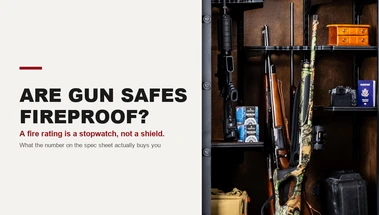
ARE GUN SAFES FIREPROOF? WHAT A FIRE RATING ACTUALLY BUYS YOU
"Fireproof" is the word everybody types into a search bar, and it is the word nobody in this business should be using. I sell safes for a living, so take this however you like: there is no such thing as a fireproof gun safe. There is no such thing as a fireproof safe of any kind, at any price, from any manufacturer, including this one.
What exists is fire resistance, and that is a different promise. It is a measured window of time during which the inside of the box stays cooler than the room around it. The window closes. The only questions worth asking are how wide yours is, what the number was measured against, and what you put inside.
The Short Answer
No. A gun safe is fire resistant, not fireproof, and the distinction is not a technicality a lawyer made us add. It changes how you should shop.
A fireproof box would imply that the contents survive regardless of how long the fire burns. Nothing does that. Steel conducts heat, every seam is a path, and a long enough fire wins every time. What a fire rating tells you is how many minutes the manufacturer expects the inside to stay below a threshold while the outside is held at a stated temperature. A fire rating is a stopwatch, not a shield.
That said, a stopwatch is worth a great deal. Most residential fires are knocked down or burn themselves out long before a two hour mark. Buying minutes is a completely reasonable thing to do with your money. Buying a word is not.
What A Fire Rating Actually Measures
The recognized standard for this is UL 72, Tests for Fire Resistance of Record Protection Equipment, currently in its ANSI/CAN/UL 72:2026 edition. It was written for filing cabinets and record safes, not for gun safes, which matters in a minute.
Under UL 72 the rating classes are built around what is being protected. Class 350 is the paper class, and the number is the ceiling: the interior may not exceed 350 degrees Fahrenheit at any point during the test, including while the unit cools back down. Class 150 and Class 125 are stricter classes meant for non-paper media like magnetic tape and photographic records, because those fail at lower temperatures than paper does. A unit is run through a fire endurance test and an explosion test, and impact resistance, the drop onto rubble that simulates a floor giving way, is tested separately.
The cool-down counts. This is the part people miss. A safe keeps absorbing heat after the fire is out, and the interior often peaks well after the flames are gone. That is why the standard measures the whole curve rather than the moment the fire department arrives, and it is why pulling a safe open too early is its own mistake.
Where The Number On The Spec Sheet Comes From
Here is the part most articles on this subject skip, and I would rather you hear it from a manufacturer than find it out later.
The large majority of gun safes sold in this country, ours included, do not carry a UL 72 listing. The fire numbers you read on gun safe spec sheets, mine and my competitors', are generally manufacturer ratings produced by the manufacturer's own testing rather than a third party listing to UL 72. That is the industry norm, and it is not in itself dishonest. It does mean the numbers are not automatically comparable between brands the way a UL listing would be.
What makes a manufacturer rating readable is whether it tells you the conditions. Ours do. A Rhino listing reads like the Raptor RX7241: rated for 80 minutes of fire protection at 1400 degrees Fahrenheit, with fireboard lining in the ceiling, walls, floor and door. Minutes, temperature, and where the lining actually is. A number with no temperature attached to it is not a rating, it is a decoration.
Here is how that reads across our gun safes, so you can see what a complete rating looks like written out:
| Rhino series | Fire rating | Measured at |
|---|---|---|
| Kodiak KBX | 45-60 minutes | 1400°F |
| Falcon FFX | 60 minutes | 1400°F |
| Longhorn LNX home safes | 60 minutes | 1400°F |
| Longhorn LGX home safes | 75 minutes | 1400°F |
| Raptor RX/RSX | 80 minutes | 1400°F |
| Lightning LX/LIX | 120 minutes | 1400°F |
| Thunderbolt TGX/TGIX | 160 minutes | 1400°F |
For reference on that 1400 degree figure: ASTM E119, the standard time and temperature curve used for rating building assemblies, calls for a furnace at 1000 degrees at five minutes, 1300 at ten, 1550 at thirty minutes, 1700 at one hour and 1850 at two hours. So a 1400 degree test sits inside the range a structural fire test uses, falling between the ten minute and thirty minute marks on that curve. Granted, E119 is a furnace curve for walls and floors rather than a model of your living room, and the standard says as much. No test is your house.
What A Real Fire Does To A Room
The U.S. Fire Administration counted 344,600 residential building fires in 2023, causing 2,890 deaths, 10,400 injuries and roughly $11.3 billion in loss. That is the backdrop. It is not a rare event and it is not something that only happens to careless people.
What matters for your safe is that a fire is not one temperature. It is a gradient, and the safe experiences whatever its own corner of the house experiences. A safe in a finished basement with a concrete floor under it is in a very different fire than the same safe on a second story bedroom floor. The second story safe has a problem the first one does not, which is that the floor underneath it can fail, and a loaded safe that falls through a burning floor lands hard, lands upside down sometimes, and lands in the hottest part of the structure.
This is why impact matters. Under UL 72, impact resistance is its own test for exactly this reason. If you are putting a safe anywhere above a basement slab, the fall is part of the fire, and it is worth thinking about when you decide where the safe lives. We walked through the placement and floor loading side of this in how to move a gun safe.
Guns Are Not Paper
Every fire rating you will read on a gun safe traces back to a paper threshold. That 350 degree Class 350 limit exists because paper chars and becomes unreadable somewhere above it. Your deeds and your birth certificate care about 350 degrees.
A rifle is a different object with different failure points, and most of them show up well below the temperature that ruins paper. Wood stocks check and crack. Synthetic stocks soften and deform. Scope seals let go and the nitrogen purge is gone, which is why a scope can look perfect and fog permanently the first cold morning afterward. Bluing discolors. Springs take a set. Cases and recoil pads melt onto what they are touching.
The serious one is metallurgical, and it is invisible. The Sporting Arms and Ammunition Manufacturers' Institute guidance on firearms exposed to fire explains that the parts which contain chamber pressure, the barrel and the lock-up components, get their strength from controlled high temperature heat treatment during manufacture, and that a fire can alter that heat treatment depending on the temperature reached and how long it lasted. SAAMI notes that the resulting deformation can be subtle enough to escape detection. A rifle that survived a fire cosmetically can still be unsafe to fire, and you cannot tell by looking.
So what does a fire rating buy for guns? Time at a lower temperature, which is genuinely worth having, and a much better chance that what comes out is repairable rather than scrap. It does not buy a guarantee that a fire-exposed firearm is safe to shoot. Nothing does except an inspection.
What About The Ammunition
This is the question I get the second the subject of fire comes up, usually phrased as whether a safe full of ammunition turns into a bomb.
It does not, and that is not me reassuring you. SAAMI's informational document on sporting ammunition fires documents fire service testing of burning ammunition, including a test run inside a small concrete block structure built to simulate a basement storage room. The findings were consistent: cartridges cook off individually rather than detonating as a mass, there was no audible evidence of ammunition exploding en masse, few projectiles traveled beyond forty or fifty feet, and even in close confinement the testing found no evidence of mass propagation through the stored ammunition.
Granted, individual rounds cooking off inside a steel box still make a racket and still batter the interior. And fire-exposed ammunition and smokeless propellant should be discarded rather than shot, for the same reason as the firearms. The point is narrower than people expect: storing ammunition in your safe does not create an explosion hazard that the safe itself causes.
The Part The Rating Does Not Cover
A fire rating describes the lining. It does not describe the gap.
The seam between the door and the body is where heat and smoke get in, the same seam that a pry bar works. A safe with a generous fire lining and a door that lets go of its frame under heat is not getting you the rated time. This is why the SafeX® Security System interlocks the door into the body rather than relying on bolts alone. A door that stays put under stress is doing fire work as well as burglary work.
The other thing no rating covers is what happens days later. A fire means water, and water means a locked gun safe full of humid air sitting in a wet house. I have seen collections survive the fire and then rust in the weeks afterward because nobody opened the safe and dried it out. That is a solvable problem and it is covered in the dehumidifier piece, but you have to actually do it.
If Your Safe Has Been Through A Fire
Work in this order. This is the recovery sequence, and the first item is the one people get wrong because they are standing in their own burned house and they want to know right now.
- Let it cool completely before you open it. The interior usually peaks after the fire is out. Opening a hot safe introduces oxygen to hot contents and can undo what the safe just did for you. Wait for the safe to be cool to the touch all over, not just on the door.
- Do not force the lock or the handle. Heat melts keypads and even manual dials. If the safe will not open normally, call the manufacturer or a safe technician and let them handle the heavy lifting. If it's a Rhino Safe, we're replacing it anyway under our Limited Lifetime Warranty.
- Expect water, and deal with it the same day you open it. Get the contents out, get them dry, wipe everything down and oil the metal. Rust starts fast on hot wet steel.
- Do not shoot anything until it has been inspected. SAAMI's position is unambiguous: a firearm exposed to fire or extreme temperatures should not be used until the manufacturer or a qualified professional gunsmith has inspected it and deemed it safe for continued use.
- Discard fire-exposed ammunition and propellant. Do not try to salvage it, and do not mix it back into good stock.
- Photograph everything before you move it. Your insurer will want the condition documented in place. If you already have a serial number inventory, this is the moment it earns its keep.
That last one is the cheapest insurance in this whole article and almost nobody does it before they need it. There is a simple system for it in documenting your collection.
How To Read A Fire Rating Without Getting Sold
If you take one thing from this, take this list. It works on my safes and on everybody else's.
- Minutes and a temperature, together. "60 minute fire rating" means nothing by itself. Sixty minutes at what? A rating without a stated test temperature cannot be compared to anything.
- Know which kind of number you are reading. A UL 72 listing and a manufacturer rating are both legitimate, but they are not the same claim. Most gun safes, ours among them, publish manufacturer ratings. Ask, and do not assume a big number implies third party listing.
- Find out where the lining is. Ceiling, walls, floor and door, or only some of those. A safe lined everywhere except the floor has an obvious weak face, and the listing should tell you without you having to call.
- Check whether the door is built like the body. Fire ratings assume the door stays shut and stays sealed. A thin door on a thick body is a fire problem before it is ever a burglary problem. Most of our safes carry the same gauge steel on the door as they do the body. Exceptions include our Thunderbolt series which actually has a 10-gauge door with a 7-gauge core. Translation: More steel in the door.
- Remember the threshold is a paper number. Rated minutes describe keeping an interior below a paper-safe temperature. Optics, stocks and finishes start suffering earlier than that.
- Match the rating to where the safe will sit. Upstairs changes the question, because the floor is part of the fire.
So, are gun safes fireproof? No, and I would be careful with anyone who tells you otherwise, because the word is doing sales work rather than describing the product. What a good safe gives you is a stretch of time measured under stated conditions, a lining that covers every face including the door, and a door that stays in its frame while the house comes apart around it. That is a real thing to buy. It is just not a magic box, and anybody who has been through this already knows the difference.
Common Questions About Fireproof Gun Safes
Are gun safes fireproof?
No. No safe of any kind is fireproof. Gun safes are fire resistant, which means the interior stays below a threshold temperature for a rated number of minutes while the outside is held at a stated test temperature. A fire rating is a stopwatch, not a shield.
What does a fire rating on a gun safe actually mean?
It means the manufacturer expects the inside of the safe to stay below a threshold for that many minutes at a stated temperature. A rating given in minutes with no temperature attached cannot be compared to anything. Rhino safes are rated in minutes at 1400 degrees Fahrenheit, with fireboard lining in the ceiling, walls, floor and door.
Are gun safe fire ratings UL certified?
Usually not. UL 72 is the recognized standard for fire resistance of record protection equipment, but the large majority of gun safes sold in the United States, Rhino safes included, publish manufacturer fire ratings rather than a third party UL 72 listing. Both are legitimate, but they are not the same claim, so ask which one you are reading.
Will my guns survive a house fire if they are in a safe?
A fire rating buys time at a lower temperature, which greatly improves the odds that what comes out is repairable rather than scrap. It is not a guarantee. Scope seals, wood stocks and finishes suffer well below the temperature that ruins paper, and heat can alter a firearm's heat treatment invisibly.
Is it safe to store ammunition in a gun safe?
Yes. SAAMI's testing of sporting ammunition fires found that cartridges cook off individually rather than detonating as a mass, with no evidence of mass propagation even in close confinement. Ammunition that has been exposed to fire should be discarded rather than fired.
Can I use a gun that has been through a fire?
Not until it has been inspected. SAAMI's position is that a firearm exposed to fire or extreme temperatures should not be used until the manufacturer or a qualified professional gunsmith has inspected it and deemed it safe for continued use. Fire damage to pressure-containing parts can be too subtle to see.
Every Rating On The Page
Every Rhino model page lists its fire rating in minutes, the temperature it was rated at, and where the fireboard lining sits. Compare them against anything else you are looking at.
Shop Gun Safes Shop DehumidifiersFire ratings shown are Rhino Metals manufacturer ratings current as of October 2026 and vary by model, so check the specifications on the product page for the safe you are considering. This article is general information about fire ratings and is not a guarantee of performance in any particular fire. For any firearm or ammunition exposed to fire, follow SAAMI guidance and have the firearm inspected before use.