
Oct 11th 2026
GUN SAFE VS. GUN CABINET: WHAT YOU'RE ACTUALLY PAYING FOR
Walk into almost any sporting goods store and you will find two products sitting a few feet apart, sold for the same reason. One is a tall, slim steel box with a glass or louvered door, a small key, and a price tag in the low hundreds. The other weighs more than your refrigerator, takes a crew to get through the front door, and costs several times as much. Both are labeled for firearms. One is not a cheap version of the other.
People ask our dealers which one they need more often than you'd think, and it usually comes down to whether a cabinet is good enough or not. That is a hard question to answer because it skips a step. The two things are not the same product at different prices, they are built to do different jobs. A cabinet keeps guns out of the way. A safe keeps them secure.
What A Gun Cabinet Is
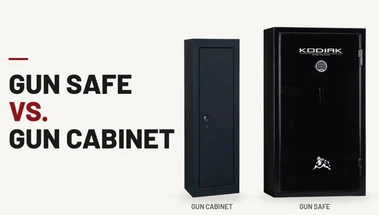
A gun cabinet is organized storage with a lock on it. The body is thin sheet steel or wood, the door is often glass or slatted so you can see what is inside, and the lock is usually a single key or a simple latch. Most cabinets weigh less than the person buying one, and that is the whole appeal. You carry it in by yourself, screw it to a couple of wall studs, and you are finished before lunch.
Cabinets do a few things genuinely well. They keep long guns upright instead of leaning in a closet corner. They minimize the dust that gathers on your collection. They keep everything in one place where you can count it and they keep firearms away from anybody who is not deliberately trying to get at them. That last part matters more than it sounds like it does, and I am not going to talk anyone out of a cabinet that is doing that job today.
That said, the same qualities that make a cabinet easy for you to live with make it easy for someone else to open. Thin metal gives a pry bar something to bend. A glass or wood panel can simply be broken out. And a cabinet light enough for one person to carry in is light enough for two people to carry out, contents and all, which is the part most buyers never picture.
What A Gun Safe Is
A safe is an entirely different animal. The body is plate steel rather than sheet metal, the door is thicker than the body, and turning the handle drives steel bolts out into the door frame on more than one side. The walls and the door are built with a fire resistant lining. It is heavy on purpose, it is pre-drilled to bolt down to your floor, and once it is anchored it is not going anywhere without tools and a lot of noise.
The other thing a safe is built to do, and this is the part that separates a real safe from a box that looks like one, is close off the gap between the door and the body. That seam is where somebody with a pry bar starts. Every Rhino safe uses our patented SafeX® Security System, which interlocks the door and the body making them virtually pry-proof. If you want the longer explanation of why that matters more than counting bolts, we wrote that one up separately.
The Difference Is Time
Nobody in this industry will tell you they sell a box that cannot be opened, or at least nobody honest will. Give a person enough time, the right tools, and no reason to hurry, and they will get into anything. So that is not what you are buying. What you are buying is time, and the only question worth asking is how much of it.
A burglar works against a clock he set himself. He does not know when you are coming home, he does not know who heard the door, and the thing he is most afraid of is still being in your house. Every minute you add is a minute he has to decide whether your gun cabinet is worth it.
Think of it as a delay, not a wall. A cabinet buys you a delay measured in moments. A safe buys you a delay long enough that most people quit and leave with the television instead. That is the entire transaction, and it is why the two products cost what they cost.
Fire Is The Part People Forget
Theft is what people shop for. Fire is what I have seen take more collections than anything else, and it takes everything at once, including the things in the cabinet that were never really about money. Papers, old photographs, your grandfather's shotgun.
A cabinet does nothing for you here. It is a metal box in a burning room, and the inside of it gets as hot as the room does. A safe is built the other way around. The walls and the door carry a fire resistant lining, and the door seals tighter as it heats, so the inside stays cool enough to matter for a stretch of time while the fire burns down or the fire department gets there.
Granted, a stretch of time is the honest way to say it. No safe is fireproof, and anybody who uses that word is selling you something. Fire resistant means a window, and a bigger, heavier safe generally gives you a wider one. What a safe is really doing is keeping your things intact long enough to still be yours afterward.
If The Worry Is Kids
Then I want to be straight with you, because this is the one case where I think the cheap answer is a real answer. If your only concern is that a curious ten-year-old or a visiting nephew cannot get hands on a firearm, a locked cabinet solves that. What stops a kid is a lock and a key the kid does not have, and a cabinet has both.
A locked cabinet in the house this week also beats a safe you plan to buy in the spring. I would rather you buy the thing you can afford now and use it every single time than wait around for the better one. The lock only works when it is locked, which sounds obvious and is still the most common failure I hear about.
Where that logic runs out is the other two risks. A cabinet handles access. It does not handle a stranger with a pry bar, and it does nothing at all about fire. If those are on your list too, you are shopping for a safe and the cabinet is a stopgap.
Weight And Where It Has To Live
This is the practical fork in the road, and it decides the question for a lot of people before price ever comes up. A cabinet goes wherever you want it. One person, a drill, two studs, done. When you move, it goes in the truck with the furniture.
A safe is a planned event. You measure the doorways and the tightest turn before you order, you think about where it sits relative to the floor framing, and depending on the weight and the route you may be better off paying a crew to set it. None of that is a reason not to buy one. It is a reason to figure it out first. We walked through both of those in detail already, in how to size a safe and in how to move one.
What They Cost
Cabinets generally land somewhere in the low to middle hundreds. Safes start higher, and ours are no exception. Our least expensive model is a Kodiak long gun safe is just over $1,-00, and the line climbs from there as the steel gets thicker, the fire lining gets better, and the safe gets bigger.
The comparison that actually helped me think about it is not cabinet price against safe price. It is the price of either one against what goes inside. A safe is a twenty year purchase, maybe a thirty year one, and it is the rare thing in your house that your kids will still be using. Spread the number across those years, then look at what you are putting in it. For most people the contents are worth several times the box. That math is uncomfortable, and it is quick.
When A Cabinet Is The Right Call
I sell safes, so you can weigh this however you like, but there are households where I would tell you to buy the cabinet and spend the difference on something else.
If two or three of those describe you, buy the cabinet and do not feel bad about it. Then anchor it into studs rather than drywall, and put it somewhere that is not the first room off the garage. A cabinet that is screwed to framing and out of sight is doing noticeably more work than one standing loose in a hallway.
Side By Side
| Gun Cabinet | Gun Safe | |
|---|---|---|
| Built from | Thin sheet steel or wood, often a glass door | Plate steel body, thicker door, bolts into the frame |
| Stops | Casual access, kids, guests, opportunity | All of that, plus hand tools and pry attempts |
| Fire | No protection | Fire resistant lining in the walls and door |
| Weight | One person can carry it, and so can a thief | Hundreds of pounds, bolted to the floor |
| Install | An afternoon with a drill and two studs | Measured path, sometimes a hired crew |
| Price | Low to middle hundreds | Starts a little under $1,000 and climbs |
| Best at | Organizing and locking up a few guns, cheaply | Keeping what is inside through a burglary or a fire |
One rule that applies to both. Anchor it. A cabinet screwed to wall studs and a safe bolted to the floor are both several times harder to deal with than the same unit standing free, and anchoring is also what keeps either one from tipping over onto somebody. Hardware often comes in the box. Use it.
So, which one do you need? If what is in your house is a couple of hunting rifles and what you need by Saturday is a lock, the cabinet is a real answer and I would rather you have one than nothing. If the thought of losing what is in there, to a stranger or to a house fire, lands somewhere other than your wallet, then you already know what I think and you are only deciding on size.
Either way, lock it every time and bolt it down. That part is not optional in either direction.
Looking At Safes
Every safe we build carries the SafeX anti-pry system, and every model page lists its weight, capacity and dimensions so you can plan the install before you buy. Start with the size you need, not the price.
Shop Gun Safes What Is SafeXPrices shown are Rhino Metals pricing as of October 2026 and are subject to change. Fire resistance and security vary by model, so check the specifications on the product page for the safe you are considering.